
simulation education program
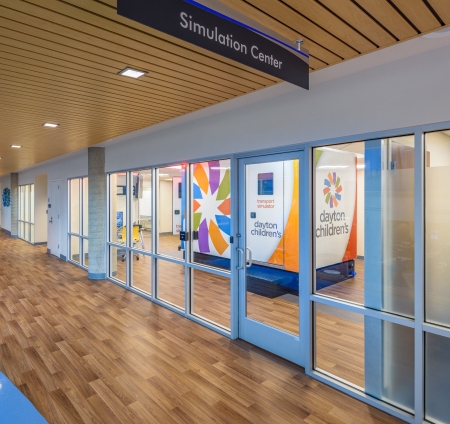
about the simulation center
Opened in 2024 at main campus, the Dayton Children’s Simulation Center is the only hospital-based facility in Ohio with an ambulance simulation, and the only one of its kind in a pediatric hospital in the United States. As one of just 140 nationwide, this technology allows providers to practice caring for critically ill or injured patients in realistic conditions. Along with the ambulance simulator, the center includes a trauma and intensive care unit room, inpatient training room, family education space, control room and debriefing rooms. Together, these spaces create an immersive environment where teams can practice procedures, refine communication and enhance patient safety without risk.
Simulation education is a vital part of preparing pediatric healthcare teams. By practicing in a risk-free environment, providers can sharpen clinical skills, strengthen teamwork and prevent errors before they happen at the bedside. Simulation ensures consistent training across staff, introduces innovative techniques and ultimately improves the quality and safety of care for children and families.
Through this education program, our mission is to utilize simulation-based training to promote patient safety and exceptional care for every child within our reach. Our vision is to operate a multidisciplinary simulation education program to enhance the quality of care provided to pediatric patients throughout our region and beyond.
types of simulation
The Simulation Center uses a variety of methods to meet different learning needs. Together, these approaches give staff a safe environment to practice essential skills ranging from technical procedures and resource management to communication and teamwork before applying them in real world care.
- Standardized patients: Trained volunteers who portray patient histories for physical exams. This method is best for teaching and assessing information gathering skills, physical exam technique, information giving and counseling, informed consent, and mass-casualty scenarios.
- High fidelity manikins: Computerized manikins that respond physiologically to simulated care. These are best utilized to teach and assess emergency skills, team skills, and decisions under stress i.e., mock codes, PALS, NRP, ACLS, PFCCS.
- Low fidelity manikins: Manikins that physically represent a patient but cannot respond physiologically to simulated care. These are best utilized to teach quick assessment skills, and minor procedures such as intravenous placement and intubation.
- Task trainers: Representations of body parts for procedural skills training such as intubation, vascular access, lumbar puncture, ultrasound imaging, minor surgeries, and laparoscopic techniques.
- Virtual reality: Computer simulations designed to teach and evaluate thinking skills, decision-making, and high-risk procedures.
- Video review: Video capture and analysis of a simulation to review for team performance and assessment of skills.

schedule a simulation training
For community providers, local schools or others who may be interested in scheduling a training, submit a request and our simulation education staff will reach out to the leader to coordinate. For additional information or questions email Greg Bader at bader42g@childrensdayton.org.
