Ayden Carrasco

Ayden discovers the right treatment for nephrotic syndrome to help him thrive
- patient name: Ayden Carrasco
- age: 9
- seen in: nephrology, rheumatology
- providers: Erin Dahlinghaus, MD, MHS and Dustin Fleck, MD
a mysterious beginning
In June 2022, Ayden began waking up with puffy eyes, something many have dealt with, especially during peak spring allergy season. The swelling wouldn’t go away so his mom, Lakia, took him to the pediatrician, where he was treated for an ear infection and allergies. But as the days passed, Ayden was not getting better. In fact, his ankles and belly were starting to swell, too.
“Something just didn’t feel right,” Lakia recalls. “As a nurse, I started researching his symptoms and nephrotic syndrome kept coming up.”
Lakia trusted her instincts and took Ayden to Dayton Children’s Hospital urgent care, where she requested blood work. Her concerns were confirmed – Ayden’s labs pointed to nephrotic syndrome. Nephrotic syndrome is a very rare condition, affecting only five out of 100,000 children each year. It affects the kidney, causing protein to leak from the blood into the urine, leading to swelling, an increased risk of infection and blood clots.

a rare diagnosis
With those suspicions, Ayden was referred to Erin Dahlinghaus, MD, MHS, division chief of nephrology at Dayton Children’s. Ayden did not make it to his first appointment because his symptoms continued to get worse. Lakia took Ayden to Dayton Children’s emergency department, where he was then admitted. He began treatment with high-dose steroids and was scheduled for follow-up care with Dr. Dahlinghaus the next week.
Before Ayden could make it to that appointment, his condition took another turn. Ayden woke up one morning crying in pain. “Ayden had a fever and was throwing up, so we went back to the emergency department where they did additional blood work that showed a high white blood cell count,” shares Lakia. Based on the elevated white count and an ultrasound, Ayden was diagnosed with a rare complication of nephrotic syndrome called peritonitis, a serious infection of fluid in the stomach. “So not only did Ayden have a rare condition, but he also had an even rarer complication to the condition,” Lakia shared.
Ayden was rushed to surgery to remove the infected fluid in his stomach. He was admitted to the pediatric intensive care unit (PICU), where he received IV antibiotics and close monitoring. But before getting discharged, Ayden had another complication. His blood pressure spiked super high, requiring additional medication before he could safely go home.
Unfortunately, Ayden still wasn’t responding to treatments like they hoped for. Over the next six weeks, he was in and out of the hospital to receive medications to help remove the fluid from his body and lower his blood pressure. Dr. Dahlinghaus decided it was time for a kidney biopsy. What she found was surprising: Ayden’s condition was caused by two separate diseases, vasculitis and focal segmental glomerulosclerosis (FSGS), a rare kidney disease that affects only about seven people per million each year.
a new diagnosis, a new direction
With this new diagnosis, Ayden began a different treatment plan that included immune-suppressing medications. While there was some improvement, it wasn’t enough. “Ayden continued to swell up and had high blood pressure, so we thought something else may be going on,” says Lakia. After more testing, it revealed that the vasculitis was actually ANCA-negative vasculitis (AAV), a rare autoimmune disease that causes blood vessels to swell.
Ayden was referred to Dustin Fleck, MD, division chief of rheumatology at Dayton Children’s, who began infusions to treat the AAV. Over time, Dr. Fleck and Dr. Dahlinghaus adjusted his medications, adding another immune suppressant to help manage his symptoms.
a long road to recovery
After a year of infusions, medications and close monitoring, Ayden finally began to turn a corner. Through trial and error, Dr. Dahlinghaus and Dr. Fleck found the right combination of treatment. At one point, Ayden was on six doses of blood pressure medications each day, two immune suppressants and regular infusions. A second biopsy revealed that Ayden had permanent damage to his kidney, meaning he would need to be on medicine for the rest of his life.
But today, three years later, Ayden is thriving. He’s down to just one blood pressure medication, no longer needs immune system suppressants, and is more active and energetic. He’s even been able to gain healthy weight and continues to follow up regularly with his care team.
what mattered most
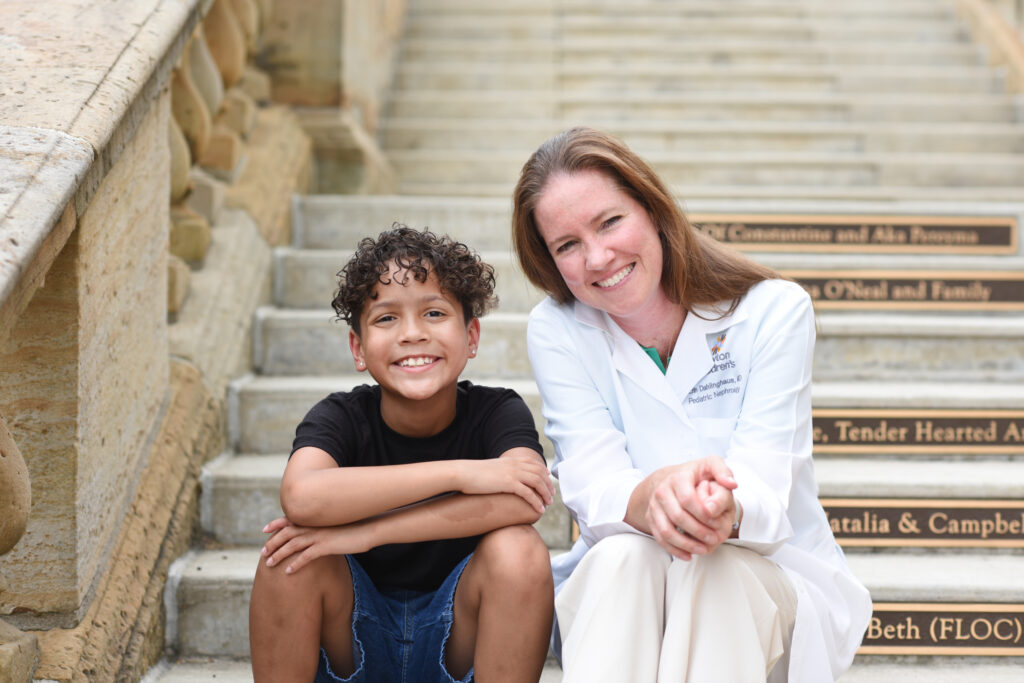
Ayden’s journey wasn’t just about medicine – it was also about the meaningful connections he built along the way! One of the strongest bonds was with Dr. Dahlinghaus. During his infusion treatments, the two often battled it out in Super Smash Bros on their Nintendo Switches.
For Lakia, the support she received from Dr. Dahlinghaus made all the difference. “She has been one of my biggest rocks throughout this whole process,” Lakia shares. “She and her team treat Ayden like he is one of their own. Her support means the world to me, and I know with her we’ve got this!”
Lakia also found comfort in their shared experience as mothers. “There was a point in our journey where Dr. Dahlinghaus sat me down and said, ‘Now is the time for you to be Ayden’s mom – let us be his care team.’ I felt a weight just lift off my shoulders. I knew Ayden was in the best hands.”
For Ayden it was finding comfort in familiarity. “Every time I had to come to the hospital, they knew what I liked and remembered me,” Ayden shared. After each visit, he’d proudly tell his mom, “I’m Dayton Children’s VIP.”
share your story
Every patient journey at Dayton Children’s is powerful — from NICU miracles to courageous cancer survivors and beyond. These patient stories not only celebrate our families but also offer hope and encouragement to others facing similar challenges. Share your experience today and help inspire, support, and celebrate the strength of our patients and families.
related stories



care that goes above and beyond
Because every child deserves care that goes above and beyond, Dayton Children’s provides compassionate, expert care for kids of all ages. Find a provider, schedule an appointment, or learn more about conditions we treat today.